How can a theatre actor show heartbreak without saying a word? Sometimes, a trembling hand, a missed glance, or a step away from someone says more than dialogue ever could.
For on-stage theatre, performance movement gives physical form to emotions, relationships, and dramatic tension. Every gesture, pause, and change in posture can reveal something about a character that words leave unsaid. Guided dance choreography brings these physical choices together and helps performers communicate a story through coordinated, purposeful movement.
For actors, choreographers, and theatre practitioners, understanding this relationship can deepen performances and strengthen storytelling. This guide explores how movement supports character development, stage composition, and emotional connection with an audience.
What This Blog Will Cover?
- How movement do brings theatrical stories to life?
- Ways choreography reveals character and emotion
- How do actors and directors collaborate on movement?
- What makes stage movement feel natural?
- How choreography builds mood, tension, and atmosphere?
- Key differences between theatre and film choreography
- Preparing performers for movement-based rehearsals
- Tips for more natural stage choreography
What Is Dance Choreography in Theatre and Film?
Dance choreography in theatre and film is the planned arrangement of physical movement to support a production’s story, atmosphere, and characters. It can involve structured dance sequences, subtle gestures, ensemble movement, or physical transitions between scenes.
Unlike a standalone dance performance, theatrical movement usually serves a wider dramatic purpose. A character’s walk might reveal confidence, while repeated gestures can suggest anxiety or frustration.
Dance choreography connects these physical details with the production’s narrative. This enables the actors to communicate meaning through movement as well as dialogue.
How Does Movement Help Tell a Story on Stage?
Movement choreography or movement direction for actors tells a story by revealing what characters feel, want, and struggle to express. It also establishes relationships between performers and shows how those relationships change throughout a scene.
Here are four ways movement choreography strengthens theatrical storytelling:
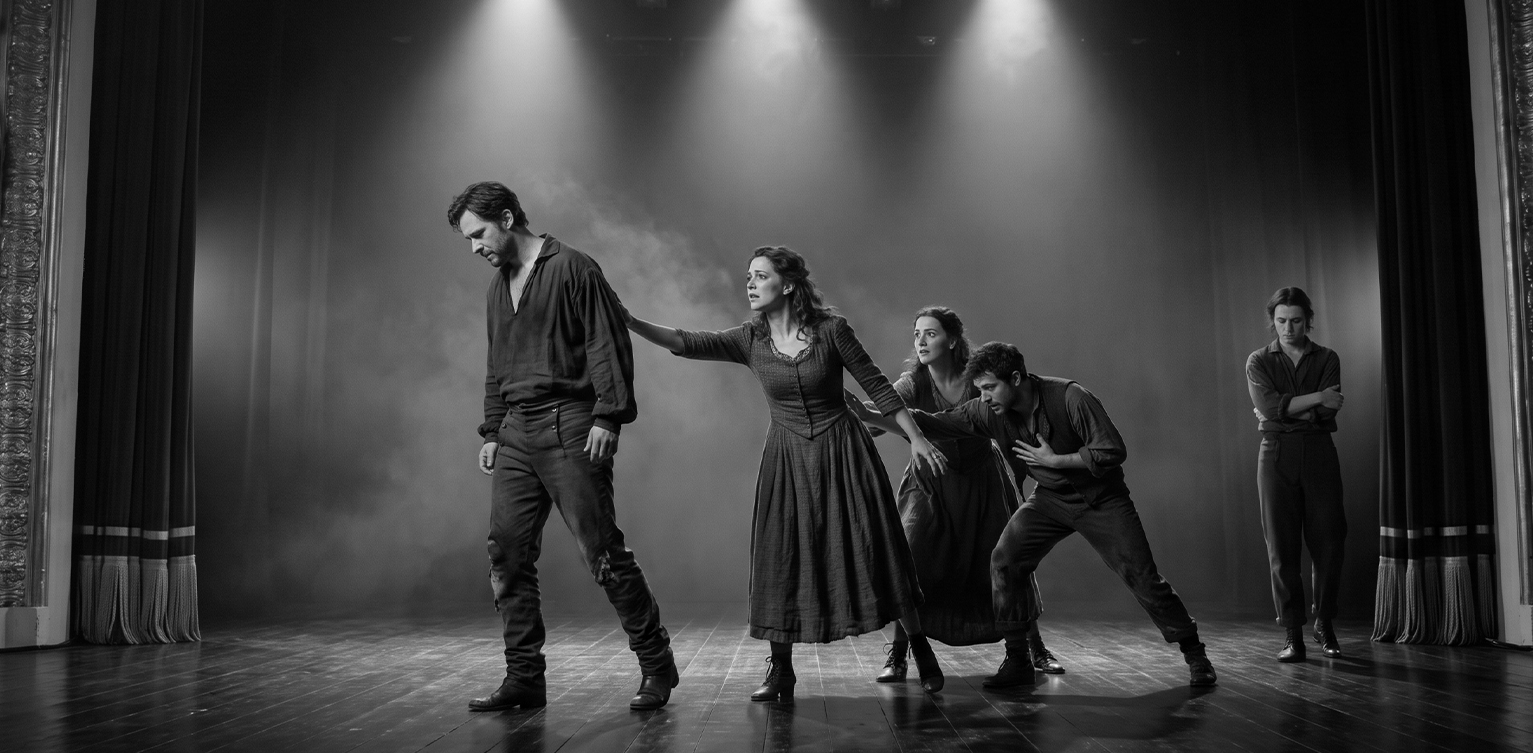
- Expressing Unspoken Emotions: A character might hesitate at a doorway or avoid another performer’s gaze. These physical choices communicate fear, uncertainty, or emotional distance without additional dialogue.
- Establishing Character Relationships: Distance, posture, and shared gestures reveal how characters relate to one another. Two performers standing close together may suggest trust, but opposing movement patterns can communicate conflict.
- Creating Atmosphere: Slow, restrained movement can establish unease. On the other hand, rapid ensemble sequences introduce urgency. The physical rhythm helps audiences sense the scene’s emotional direction.
- Connecting Movement With Narrative: Australian Dance Theatre’s THE HUM provides a useful example of dance theatre as a performance form. Productions that place movement at the centre of their storytelling show how physical expression can carry meaning beyond spoken dialogue.
How Does Dance Choreography Shape a Character?
Choreography supports character shaping by giving performers physical behaviours that reflect personality, intention, and emotional change. A character’s movement can evolve as their circumstances or relationships shift.
Here’s how stage choreography shapes a character:
- Building a Physical Identity: A character might walk with rigid shoulders, quick steps, or a consistently lowered gaze. These recurring details help establish a recognisable physical presence.
- Showing Emotional Change: Movement can shift as a character becomes more confident, distressed, or vulnerable. A previously guarded performer might gradually occupy more space as their circumstances change.
- Establishing Character Habits: Repeated gestures, restless hands, or deliberate pauses can suggest habitual responses. When these patterns change, audiences may recognise an important development in the character’s journey.
- Connecting Body and Intention: Performers need to understand why a character moves in a particular way. This relationship between intention and action gives physical choices meaning rather than turning them into decorative gestures.
How Do Choreographers Work With Actors and Directors?
Choreographers collaborate with actors and directors to connect movement with the production’s dramatic intention. Their work depends on communication, rehearsal, and a shared understanding of each scene.
Choreography for actors can include gestures, walking patterns, and coordinated physical actions that support character and narrative. Take a look at the breakdown of how choreographers interact with both roles:
- Understanding the Scene: A choreographer discusses the character’s objective, emotional stakes, and relationships with the director. These details guide movement choices that support the scene.
- Working With Actors: Actors bring personal instincts and interpretations into rehearsal. Collaborative exploration with them develops gestures and rhythms that feel believable for each character.
- Supporting Directorial Vision: Directors establish the production’s tone and dramatic structure. Choreographers translate those ideas into physical actions that complement dialogue, lighting, and staging.
- Adapting During Rehearsals: Movement changes as scenes develop and actors discover new possibilities. Regular discussion keeps choreography practical, expressive, and consistent with the production’s needs.
What Makes Movement Feel Natural in a Theatre Performance?
Natural movement grows from a character’s intentions, circumstances, and physical habits. Rather than adding gestures for decoration, performers need clear reasons for each action.
Thoughtful movement coaching can help performers explore natural physical choices that don’t make their gestures feel mechanical. These elements are essential for making movement feel natural in theatre and film.
- Start With Intention: Decide what your character wants from another person. Movement becomes more convincing when every action supports that objective.
- Respect Individual Physicality: Consider your character’s age, energy, confidence, and circumstances. Small adjustments to posture or pace can communicate these differences.
- Follow the Scene’s Rhythm: Let pauses, dialogue, and reactions influence your timing. Movement feels less forced when it responds to what happens around you.
- Use Space With Purpose: Consider distances between performers, entrances, exits, and important objects. Having right spatial awareness helps actions feel connected to the environment.
- Allow Room for Discovery: Rehearsal should leave space for experimentation and adjustment. Collaborative creative movement direction can preserve structure without making every gesture feel mechanical.
How Can Dance Choreography Build Mood and Emotion?
Dance movement choreography can establish mood through speed, rhythm, energy, and the relationships between bodies. Slow gestures may suggest grief or hesitation, while sharp, repeated actions can create tension. Music, lighting, and spatial patterns strengthen these impressions further.
Effective choreography supports the scene’s emotional direction without requiring performers to explain everything through dialogue.
How Does Choreography Change From Theatre to Film?
Choreography shifts dramatically from theatre to film because directors change how movement is staged and viewed. Live performance relies on a fixed perspective. However, film uses dynamic camera angles to capture the action.
Here are 5 key differences between stage and screen choreography:
- Spatial Orientation: Theatre choreographers design for a fixed, single-front audience perspective. Film choreography constantly adjusts to shifting camera angles and 360-degree viewpoints.
- Scale of Movement: Stage dancers use broad, exaggerated gestures to reach the back rows. Film captures subtle facial expressions and micro-movements via close-up shots.
- Temporal Editing: Live theatre requires continuous, uninterrupted physical performance from start to finish. Film uses strategic camera cuts to stitch separate takes together seamlessly.
- Depth Perception: Theatre relies on physical blocking and stage lighting to create depth. Film utilises lens magnification and camera movement to manipulate spatial dimensions.
- Environmental Control: Stage performers adapt to a consistent, flat wooden floor every night. On the other hand, film actors often perform in unpredictable on-location environments like streets or rain.
What Should Performers Know Before Rehearsing Movement?
Before rehearsals begin, performers should understand the scene’s purpose, physical demands, and practical limitations. Preparation helps everyone work collaboratively and respond confidently to direction. Movement direction for actors can connect physical choices with character intention, scene dynamics, and the director’s wider vision.
- Read the Scene Carefully: Understand your character’s objective, relationships, and emotional changes. The script provides context for physical decisions during rehearsal.
- Know Your Physical Limits: Communicate injuries, accessibility needs, or movements that cause discomfort. Choreography should account for individual capabilities and production requirements.
- Understand the Space: Check stage dimensions, flooring, props, entrances, and exits. Familiarity with the environment supports clearer movement choices.
- Discuss Creative Intent: Ask the director or choreographer what each sequence needs to communicate. Shared intentions make rehearsal decisions more focused.
- Prepare to Experiment: Arrive ready to test different gestures, rhythms, and physical responses. Flexibility helps you find choices that feel authentic.
Tips for Making Dance Choreography Feel Natural On Stage
Convincing stage movement comes from clear intention and consistent rehearsal. Small adjustments often communicate more than elaborate gestures performed without dramatic purpose. Movement choreography works best when rhythm, physical expression, and character intention support the same dramatic moment.
- Begin With Simple Actions: Explore walking, turning, pausing, and reaching. Basic movements can reveal character more effectively than unnecessary complexity.
- Connect Movement With Dialogue: Let gestures respond to spoken words and emotional shifts. Physical actions should support the scene rather than compete with it.
- Practise Rhythm and Timing: Rehearse transitions, pauses, and changes in pace. Consistent timing helps performers move together without losing expressive freedom.
- Stay Aware of Others: Notice your fellow performers and their positions. Responsive movement makes interactions feel immediate rather than rehearsed mechanically.
- Review and Refine: Watch rehearsals when possible and discuss adjustments with collaborators. Small changes to posture, spacing, or timing can improve clarity.
Bring Movement Into Your Next Creative Project
When a performance or visual concept lacks a clear physical language, even strong ideas can feel disconnected. As a stage movement coach in Queensland, I’m developing my movement direction practice across stage, screen, and fashion-related projects.
My movement direction practice explores posture, gesture, rhythm, spatial awareness, and physical storytelling to help communicate a character, concept, or creative vision. I’m interested in collaborating with directors, actors, musicians, photographers, stylists, and brands to explore how intentional movement can strengthen a performance or visual narrative.
Through creative private lessons, I can work with you to explore the concept and develop movement ideas that support your creative direction.
Do you have a theatre performance, film, or creative vision in mind? Let’s discuss how movement could bring your ideas to life.
Frequently Asked Questions
1. How does choreography help actors express emotions on stage?
Choreography gives actors physical ways to communicate emotions that dialogue may not fully express. Gestures, posture, timing, and distance can reveal fear, attraction, conflict, or uncertainty. These choices work best when they reflect the character’s intentions and circumstances.
2. Can theatre choreography work without traditional dance movements?
Yes. Theatre choreography can include walking patterns, gestures, stillness, repeated actions, and carefully arranged interactions. These physical choices can carry dramatic meaning without conventional dance steps. The important consideration is whether movement supports the scene and its characters.
3. What skills should a theatrical choreographer develop?
A theatrical choreographer benefits from movement literacy, musical awareness, spatial understanding, and clear communication. Collaboration with directors and performers is equally important. Understanding dramatic intention helps ensure that physical sequences contribute to the story rather than distract from it.
4. How does choreography differ between musical theatre and straight plays?
Musical theatre often integrates dance with songs, musical structure, and ensemble sequences. Straight plays may use more restrained movement to support character relationships and dramatic action. Both approaches require physical choices that remain connected to the production’s overall storytelling.
5. How can actors improve their physical expression?
Actors can practise posture, gesture, walking patterns, spatial awareness, and changes in movement tempo. Observing everyday behaviour can also reveal useful physical details. Recording rehearsals helps performers assess whether their actions communicate clearly without becoming exaggerated or repetitive.
6. Why is ensemble coordination important in theatre?
Ensemble coordination keeps performers aware of shared timing, spacing, and movement patterns. It helps group sequences appear connected rather than fragmented. Consistent rehearsal also supports safe stage movement, clearer sightlines, and smoother transitions between dramatic moments.
7. How does movement direction support actors during rehearsals?
Movement direction helps actors explore how physical choices relate to character, staging, and narrative intention. It can clarify gestures, spatial relationships, and transitions. The process works best when it responds to the production’s needs and leaves room for performers’ creative contributions.
8. Can movement tell a story without dialogue?
Yes. Movement can communicate relationships, conflict, emotional shifts, and changes in power without spoken language. Audiences interpret posture, gesture, distance, and rhythm through context. Clear physical choices allow a scene to convey meaning even during extended periods of silence.
9. How do directors and choreographers collaborate on theatrical movement?
Directors establish the production’s dramatic vision, while choreographers develop movement that supports it. They discuss character intentions, stage composition, timing, and transitions during rehearsal. Ongoing communication helps the movement remain consistent with the script and the production’s visual language.
10. Is dance training necessary for theatrical movement work?
Formal dance training can be useful, but it is not essential for every theatrical movement task. Performers can develop physical awareness through acting exercises, improvisation, and movement coaching. The appropriate training depends on the production’s requirements and each performer’s existing abilities.
11. What makes physical storytelling effective in theatre?
Effective physical storytelling connects movement with character intention, dramatic context, and audience perspective. Gestures and spatial choices should communicate something meaningful within the scene. When movement has a clear purpose, it can deepen emotional understanding without unnecessary explanation.